

Understanding how to find the area of a pentagon might sound like a math teacher’s secret code, but it’s easier than it seems. Picture this: five sides, five angles, and a whole lot of potential for fun! Whether you’re designing a quirky garden or just trying to impress your friends at trivia night, mastering the art of pentagon area calculation can be your ticket to geometric glory.
But don’t worry, no need to summon your inner math wizard. With a sprinkle of simple formulas and a dash of creativity, anyone can conquer this shape. Dive in and discover how to unlock the secrets of pentagons without breaking a sweat—or your calculator! Get ready to unleash your inner architect and impress everyone with your newfound knowledge.
Understanding Pentagons
Pentagons have a distinct set of properties that make them unique in geometry. Recognizing their features helps in grasping how to calculate their area effectively.
Definition and Characteristics
A pentagon is a five-sided polygon characterized by five angles. Each interior angle measures less than 180 degrees in a regular pentagon. Such regular pentagons display equal side lengths and angles, highlighting symmetry. In contrast, irregular pentagons possess varying side lengths and angles, introducing complexity. Understanding these basic traits lays the groundwork for further exploration of pentagon areas.
Types of Pentagons
Two main types of pentagons exist: regular and irregular. Regular pentagons maintain uniform side lengths and angle measures. Irregular pentagons, however, showcase diverse side lengths and varying internal angles. Notably, some pentagons could be concave, with at least one interior angle exceeding 180 degrees, while others remain convex. Distinguishing between these types allows for more accurate applications in area calculations.
Methods to Find Area of Pentagon
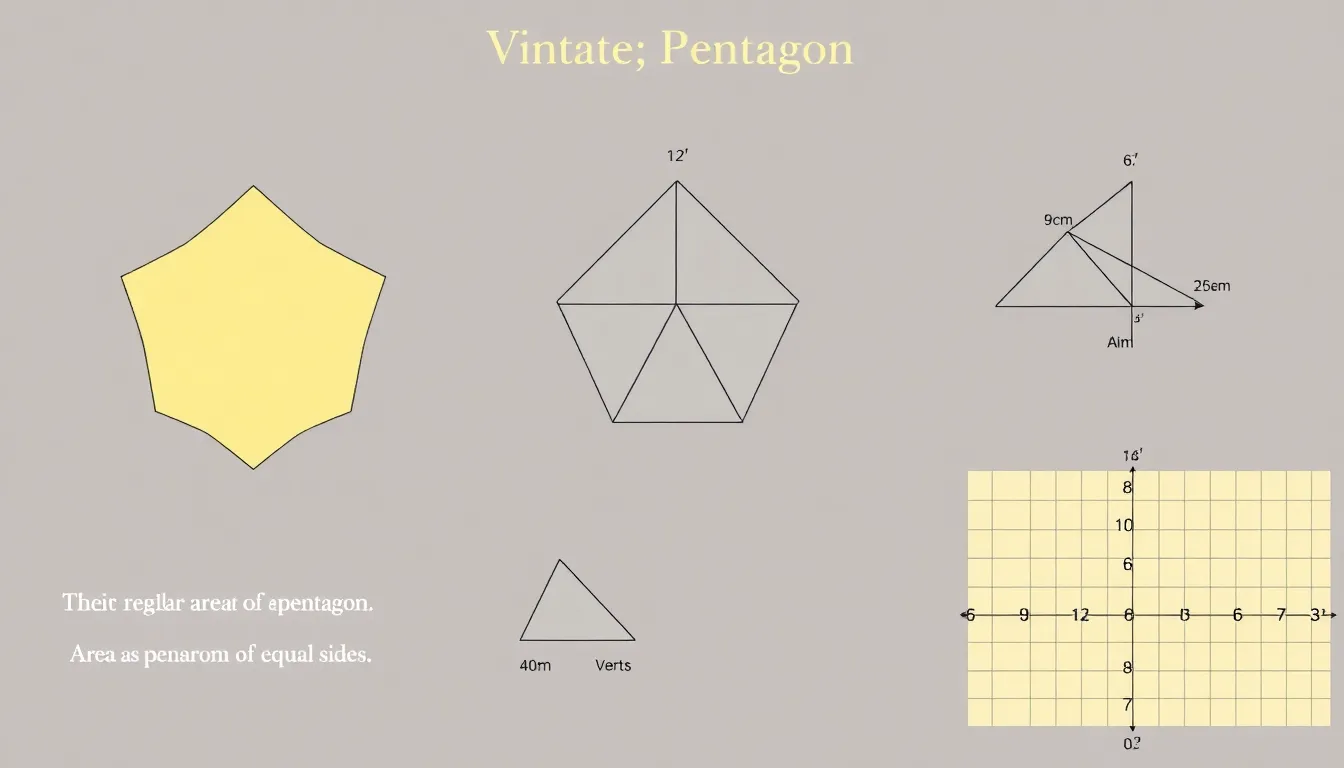
Calculating the area of a pentagon can involve various methods tailored to the specific type of pentagon being analyzed. Here are three effective approaches:
Using the Standard Formula
The standard formula for the area of a regular pentagon is given by ( A = frac{1}{4} sqrt{5(5 + 2sqrt{5})} s^2 ), where ( s ) represents the length of a side. Applying this formula offers a straightforward way to determine the area. For instance, if the length of one side equals 6 units, substituting this value gives an area of approximately 61.6 square units. Regular pentagons are characterized by equal sides and angles, making this formula applicable in such cases.
Decomposing into Triangles
Breaking a pentagon into triangles provides another effective method for area calculation. This approach involves drawing diagonals from one vertex to connect with non-adjacent vertices, forming several triangles. Each triangle’s area can be calculated using the formula ( A = frac{1}{2} b h ), where ( b ) is the base and ( h ) is the height. After calculating the area for each triangle, summing these areas produces the total area of the pentagon. This method is especially useful for irregular pentagons.
Using Coordinates for Irregular Pentagons
Using coordinates represents a practical technique for finding the area of irregular pentagons. Applying the shoelace theorem allows for precise calculations. By listing the vertices in a coordinate plane and applying the formula ( A = frac{1}{2}
| x_1y_2 + x_2y_3 + x_3y_4 + x_4y_5 + x_5y_1 – (y_1x_2 + y_2x_3 + y_3x_4 + y_4x_5 + y_5x_1) |
), the area can be effectively determined. This method accommodates pentagons with varying side lengths and angles, enhancing versatility in calculation.
Practical Examples
Calculating the area of a pentagon may seem challenging, yet practical examples clarify the process effectively.
Area Calculation for Regular Pentagons
For regular pentagons, the formula involves side length. The area equals (frac{1}{4} sqrt{5(5 + 2sqrt{5})} times s^2), where (s) represents the side length. For instance, if a pentagon has a side length of 6 units, the calculation would yield an area of approximately 61.6 square units. This straightforward approach simplifies pentagon area determination for uniform shapes.
Area Calculation for Irregular Pentagons
Irregular pentagons require a different method for area calculation. One practical approach involves dividing the pentagon into triangles. Measuring the base and height of each triangle facilitates easy computation. Alternatively, coordinates can be used with the shoelace theorem. By plotting points for each vertex on a grid, it’s possible to calculate the area accurately. This method accommodates a variety of side lengths and angles, ensuring versatility in area calculations.
Common Mistakes to Avoid
Understanding pentagons involves recognizing common misconceptions and avoiding formula errors. Ensuring accuracy in calculations requires attention to detail.
Misunderstanding the Shape
Misidentified pentagons can lead to incorrect calculations. It’s essential to distinguish between regular and irregular pentagons. Regular pentagons have equal sides and angles, while irregular ones vary in dimensions. Some individuals mistakenly refer to concave pentagons as regular, which can cause confusion. Observing the internal angles of the pentagon also provides critical insights. Recognizing that regular pentagons have angles measuring 108 degrees each aids in accurate comprehension. Clear visualization, such as sketching, benefits accurate area calculations.
Incorrect Use of Formulas
Using incorrect formulas remains a prevalent mistake when calculating pentagon areas. For regular pentagons, applying the formula ( frac{1}{4} sqrt{5(5 + 2sqrt{5})} times s^2 ) is crucial. Misapplication of the area formula for triangles or other shapes leads to erroneous results. Remember that irregular pentagons require different approaches, like decomposing them into triangles. Failing to account for varying side lengths and angles can produce significant errors. Verifying each step of the calculation ensures precision and accuracy throughout the process.
Mastering the area calculation of a pentagon opens up a world of creative possibilities. Whether designing a garden or tackling a geometry project understanding the nuances of regular and irregular pentagons is essential.
Using straightforward formulas and methods like the shoelace theorem empowers anyone to tackle this task with confidence. By avoiding common pitfalls and ensuring accurate identification of pentagon types readers can achieve precise results.
With practice and a bit of creativity anyone can become adept at calculating the area of pentagons and apply this knowledge in various practical scenarios.

